Saturday, August 17, 2019

A Dreadful Occurrence (Excursions into the Petty Sessions Part 2)


Continuing with the findings on Charles Webster (click here for first part). In 1862 he was fined 2/6 for having an unregistered dog and then was the subject of several entries until 1866 in the Victoria Petty Sessions for Maldon.

The local district became a borough in 1863 and residents were subjected to increased rates or taxes as the next time Charles pops up is with a number of people appealing against these charges. Some were upheld, others dismissed or reduced. Charles’ brother T.B (Thomas Brown) Webster is also shown with his charge being “struck out” whereas Charles’ charge was reduced to £60.

The following year 1864, Charles was defending himself against someone with the surname of Reynolds who accused him of: “Assuming the title of medical practitioner”. The case was dismissed, but it suggests that the chemist/druggist Charles may have had ideas above his station and someone called him to account although the person officiating decided it was too trivial to bother about and it was dismissed.

Early in February 1866, an Alessandro Rainoni accused Charles Webster of Assault - in what manner is not revealed - but the case was also dismissed.

TROVE online carries many detailed reports of the “Dreadful Occurrence at Maldon” that took place on 6 August 1866, the basic facts being as follows:-

Charles Webster shot dead one Frank (or Francis) Silverwood, a local Miner, at the rear of his premises in High Street, Maldon.

Silverwood had gone to the rear of Charles’ premises around 10 pm, possibly to see either him or Charles’ partner, Dr. Craig, about a medical matter. Apparently Charles had attended Silverwood and his wife Alice previously when a child of theirs was ill.


Photo of Maldon in 1867, taken by Jonathon Moon, just a year after Frank Silverwood was shot
Maldon Museum and Archives Association

It seems that there had been earlier mystery disturbances at night behind Webster’s house when suspicious individuals (allegedly “Chinamen”) were thought to be after the fowls and Charles had primed a double-barrelled shotgun ready to scare them off should they return. 

Charles stated that he heard the prowler, went outside, but it was too dark to see. He called out “Who’s That?” and when he had no answer, fired off the gun. 
“Alas! the chance shot proved a deadly aim. Lights were produced, and the dead body of Mr Frank Silverwood found; the charge had penetrated like a bullet into or just under the left temple … Mr Webster placed himself in the hands of the police until the inquest is known.”

The initial inquest into Frank Silverwood's death was held at the Beehive Hotel (R)
Photo J. Moon, c. 1867, State Library of Victoria

At the trial on 9 October, the Crown Prosecutor discussed the gravity of the charge, the differences between murder with intent and manslaughter, and also asked the obvious question why Charles didn’t use a safer method if he just wanted to alarm the intruder, i.e. load the gun with powder but not shot [or aim high perhaps?]. It was also puzzling as to why Silverwood did not answer when Charles called out.

The trial makes for fascinating reading but is too lengthy to reproduce here in full, so please follow TROVE and click here to read.

The judge decided that the case was manslaughter, and the Defence convinced the jury that it was an unfortunate accident, that Charles was filled with remorse. He was acquitted.

Interestingly, on 12 October 1866, Charles was again up in the Petty Sessions, this time as the Complainant against another Assault on him by Mrs. Craig - was she connected to the same Dr. Craig who was his partner at the time of the shooting of Frank Silverwood? Why was Mrs. Craig angry? What form did the “assault” take? Verbal or physical? Unfortunately the questions remain forever unanswered as the Petty Session Register does not show any resolution, simply the signature of the person who chaired the session.

As Frank Silverwood was well-known and respected in the community and left a widow and two daughters, Margaret, 12, and Mary Embley, 2, there could have been repercussions; perhaps some did not agree with the verdict or had suspicions as to what really happened. The original Letters of Administration granted to Alice Silverwood can be read via Ancestry but the trail on her and her daughters goes cold. ***

At this distance in time, one can only make assumptions about Charles, but together with the “dreadful occurrence”, the Petty Sessions records do provide some evidence that he may have had a short fuse, possibly was inclined to drink, as were many men in that area, or maybe he took some of his own weird drugs to relieve his state of mind. 

It appears Charles must have wanted to leave the district for some time as he had tried to offload his chemist and druggist business at least two years prior to the shooting, as per this advertisement from 13 May 1864 in the Businesses for Sale column of the Melbourne Argus:-


TO LEGALLY-QUALIFIED MEDICAL PRACTITIONERS - WANTED - Immediately, a legally-qualified Medical Man to take a practice which has been carried on successfully for the last six years by the advertiser, who is compelled to relinquish the same.
For further particulars, apply to -

CHARLES WEBSTER, Chemist, MALDON

Another image from c. 1867 of High Street where Charles Webster had his Chemist and Druggist business
Photo J. Moon, State Library of Victoria.


The reality is, not being a qualified doctor one can attribute more than a degree of quackery to Charles and his name was in the newspapers again at the end of the year in connection with a case with the lurid title of “Death of a Lunatic at the Gaol”. Read the full report on TROVE here.

Hannah Williams, 32, seems to have suffered some sort of hysterical episodes for no apparent reason which involved fights with a neighbour, leaving her husband and dumping her clothes in the street. 

Her husband took her to Charles who kept giving her some unnamed pills that knocked her out, then another doctor was called who “ordered her hair to be cut and mustard plasters applied to her legs”.  Hannah “before her excitement” complained about a man trying to take advantage of her.

Given Charles Webster’s recent history, this paragraph is interesting: 
“Charles Webster, practising as a medical man at Maldon, but not legally qualified, visited the deceased at the request of Mr. Williams. He found her in a state of great excitement, which arose in his opinion from functional disease [constipation?]. He gave her one drop of Croton oil [a highly toxic purgative] which did not act; on Sunday morning she was still more excited and he gave her some saline purgative, consisting of tartrate of soda, which operated [worked].”
This was followed by more visits by other doctors and poor Hannah wound up in a strait jacket in Castlemaine Gaol, hardly the place for someone suffering “acute mania”. It was intended she be removed to the Yarra Bend Asylum but she died before this could be done. A Dr. McGrath opened her up and “found great congestion of the brain and its membranes; there was no organic disease of the brain itself.” 

Castlemaine Gaol c. 1861 where poor Hannah Williams died
State Library of Victoria


The newspaper discussed the problems of keeping “lunatics” in gaol when they should rightly be in the asylum, but one can’t help wondering if the hair-cutting, mustard plasters and sedative/purgative treatment by Charles Webster and other dodgy medical men hastened her demise. 

So where did Charles go? 

A surprising entry in the 1871 UK Census shows a Charles Webster visiting the farm Tregaminion Wollas which is right on the tip of Cornwall at Landewednack. He gives his occupation as “Surgeon, University of Glasgow”. His age and birth place of Cheney Sutton, Leicestershire, fits exactly with our Charles Webster.


What was he doing there? Did he return to Britain and properly complete his medical studies at Glasgow, or was he continuing to give the illusion of being a doctor in far-flung places where his dubious past in Maldon would be unknown? He is not listed in the official Calendar of British Physicians and Surgeons, 1830-1923.

A search of British Newspapers finds a C. Webster, Surgeon, mentioned a few times in inquests and other cases held at Bewdley, Worcestershire, during the 1870s and as there is no close matching individual to be found in the relevant records, there is a chance it could be our Charles but the evidence is circumstantial.

From public trees available on Ancestry, it is seen that Charles came from a very large family. The brother mentioned in the murder/manslaughter of Silverwood, Thomas Brown Webster was a mine manager and well-established in the Maldon community. He is buried in the Maldon Cemetery and is the ancestor of many still living in the district. (Charles does not appear to have been married.)

One Webster brother ended his days in Pennsylvania and Charles may well have travelled on to the USA or some other corner of the world, but researching him any further is beyond the scope of this tale and so he slips through the cracks of history. 


*** Francis Silverwood was born in Yorkshire in 1827. He married Alice Embley in 1852 in Clitherhoe, Lancashire, and sailed to South Australia in 1855 on the Europa. Francis was a Blacksmith by trade and as this was the height of the Gold Rush he must have decided to leave Adelaide and seek his fortune in the Victorian Goldfields. The estate documents indicate that he had less than five hundred pounds in assets. Anyone reading this who knows what happened to Alice and her daughters, please do get in touch.


Wednesday, July 31, 2019

Excursions through the Petty Sessions. (Introduction)


For anyone with an interest in the social history of a specific time, place and/or individuals, one of the best resources available can be records of the Petty Sessions.

The Courts of Petty Sessions were local to a district and usually overseen by a justice of the peace or magistrate. Originating in England in the early 1700s, they dealt with minor matters such as theft or larceny, assaults, drunkenness, debts, licensing, deception or defamation and even allegations of illegitimacy. 


Experienced magistrates would have heard all the typical excuses! 


Any case that the magistrate could not resolve or was deemed to be more serious would be sent on to a higher court in a nearby major town or city. Most British colonies in the 1800s followed the English system.


Bram Stoker, author of Dracula,
wrote a book about the duties of Petty Sessions Clerks
Irish Family History Centre


Cover from a typical 19th C Petty Sessions record book
This one for Colac, Victoria, 1849-1865


Within those records, there are often shocks and surprises for those who are researching their ancestors. For historians, there is much intimate detail that can be revealed about what was going in a certain society at a particular time. There are rules, regulations and fines that today may seem to us onerous or unjust. The foibles and personal lives of individuals are made public, whether to do with debt, drunkenness or assault. Often, the magistrate makes arbitrary comments on failures in moral standards. But it is the glimpses into the gossip, jealousy and squabbling that was, and still is, common to small communities that can be the most fascinating.

A browse of the entries from the mid-19th Century collection, Victoria Petty Sessions for Maldon (Australia), has led me to investigate some individuals in more depth and with intriguing results, and this will be the first in a series of posts generated by some such cases.


Maldon Court House built c. 1861
This painting by Henry J.C. Mitchell from 1864 shows the Volunteer Rifle Corps
drilling in front of it.


The building is little changed today
Heritage Council Victoria.


Here is a snapshot of a single page of the Petty Sessions listing the issues heard at Maldon between 28 November and 9 December 1862:-

Assaults. Various outcomes. Fines between 5/- and 10/- (five and ten shillings) or the option of 12 hours of hard labour or 24 hours in prison. Perhaps some of the defendants had little money and opted for prison or hard labour.

Damage. Not specified what was done, but stated to be £2.12s.0d. (two pounds twelve shillings). No result as the defendant was remanded until another day.

Debts. Various. In one case a debt of £6.18s.7½d (Six pounds eighteen shillings seven pence halfpenny) was resolved by the defendant agreeing to pay off the debt at 7/6 (seven shillings and six pence) per week.

Theft. “Illegal detention of a tent and seven goats, value £8”. Defendant to repay.

Animals. These disputes can get quite complicated. They include the following:

For “killing a goat worth 10/-,” the defendant agreed to pay plus costs.

Three men were charged with “Permitting horse/s to wander on the public street” each fined 5/-.

Four men were charged with “Keeping unregistered dog/s” and fined.

Of the latter, two were well-known businessmen in the town of Maldon, Charles Webster, a Chemist, and George McArthur, a Baker. They are entered consecutively in the Petty Sessions and likewise they have adjacent advertisements on a page from the 1864 directory as shown below.

George McArthur and Charles Webster both had to cough up 2/6 (two shillings and sixpence) for having unregistered dogs. In the remarks column, it seems Charles did not follow up the fine by registering his dog, although George subsequently did. Is this is a subtle clue as to a difference in character; George perhaps more willing to be seen to do the right thing and have it recorded?

The two men pop elsewhere in the Petty Sessions for a variety of reasons. George McArthur left a lasting and mostly positive legacy in Maldon but within two years Charles Webster would be facing the death penalty when he was indicted for murder!

More on that in the next post ...


“Tarrangower, past and present: a history of Maldon from 1853. Guide, business directory and calendar. Reminisences of the good old times by Jonathon George Moon.” pub. 1862


Sunday, April 28, 2019

Twin blows and the end of the line. (The Greys of Falldon, Part III)


(Continues on from previous blogs about the Greys of Fallodon. Part I, Part II)

1928 was a bad year for Edward Grey, 1st Viscount Grey of Fallodon, as he suffered two close personal tragedies.


(In 1914, he had lost a second brother and the heir presumptive to the title, Alexander Harry Grey, who died without issue aged 44, after years of service in the West Indies as Vicar of St Jude's, Arima, Trinidad. There is little on record about him and some sources suggest that he had suffered a form of brain damage after being hit by a cricket ball as a child.)

Then, on 28 September 1928, his last surviving brother, Charles Grey, was fatally wounded in a similar fashion to that of George Grey in 1911: in Africa by a wild animal. This time it was a buffalo rather than a lion and the incident took place in Tanganyika, and he died at Tabora. 


The African buffalo is one of the most dangerous animals in the world, often called “the widow-maker”. Its weight, strength and speed has been the undoing of many a hunter.

Always dangerous. See this article in The Telegraph


Like his brother George, Charles Grey had had an adventurous career in Africa. He accompanied George in the exploration and development of the copper fields of Katanga but often travelled independently with his own boats and native carriers while exploring the lesser-known regions.

He was also a keen long distance cyclist (see Part II on George Grey). According to a correspondent in The Times:

“… On hearing the news of the outbreak of war in August, 1914, Mr Grey rode 500 miles on an ordinary bicycle to reach the nearest place where he could get into the fighting. He joined a company of the King’s African Rifles in East Africa as a lieutenant. Shortly afterwards, in an engagement against a very superior force of Germans, he was severely wounded in the left hand and forearm. Only first aid was available, and Mr Grey had to walk 22 miles to Kisumu, the nearest place where he could obtain surgical treatment. There his arm was amputated 6 in. below the shoulder, and when he had sufficiently recovered he returned to England, where he underwent two further operations. In the following year he went back to Africa and joined General Northey’s army, serving under him on the Intelligence Staff till the end of the War, being mentioned in dispatches and receiving the Military Cross. He became an expert shot with a rifle, in spite of the loss of his arm, and his death was the result of injuries that he received from a wounded buffalo while he was hunting in Tanganyika, accompanied only by four of his native servants. He was man of singular integrity, courage, and charm, and greatly beloved by every one who knew him.” [The Berwick Advertiser 4 October 1928.]

As with the real story of George Grey (see Part II), there is much about Charles Grey and his exploits in Africa that are unknown today. A book called Adventures in Africa Under the British, Belgian and Portuguese Flags by John B. Thornhill is one of the few sources on this elusive character and it describes how, while he was manager of the Tin Belt in Katanga and with the help of another white man and a group of their servants, Charles confronted and killed around twelve marauding slave traders.  Although having only one arm, it was due to his fluency in Swahili that he was made an intelligence officer during the WW1 East African Campaign.

Probably his last voyage. 1926 Passenger List for SS Llandovery Castle to Mombasa.
Charles gives the cryptic occupation of "Research Work"


Location of Tabora - centre of Tanganyika Territory


National Probate Calendar, UK


A few weeks after Charles died, on 18 November 1928, while residing at her country estate in Wiltshire, the second Lady Grey, the former Pamela Wyndham, became acutely ill (with what exactly is difficult to establish) and in spite of emergency attendance by a doctor was dead within hours. She was 57.

Lord Edward Grey was away at Fallodon in Northumberland and had to make an emergency dash to be at her side. This involved stopping the overnight Edinburgh-London express to pick him up. He was a director of the LNER (London and North Eastern Railway) at the time and had his own private railway station. Apparently he boarded the train at 10 pm without even bothering to pack. Early in the morning of 19 November, Pamela’s son, Lord Glenconner, met his stepfather in London with the sad news that he was too late.

Lady Grey was a popular figure in high society and widely mourned. A writer of prose, poetry, memoirs and children’s books, she had taken a particular interest in spiritualism following the death of her eldest son from her first marriage, Edward Wyndham Tennant, during the Battle of the Somme.

Her book on the subject The Earthen Vessel deals with “book tests”, in which the departed sent their messages via a medium and directed the living individuals to messages contained in extracts from various books. The medium in this case was Gladys Leonard, who chanelled an Indian woman called Feda. Mrs Leonard could not possibly have had intimate knowledge of all the specific libraries Feda mentioned, let alone the books contained in them, and so was merely the conduit for the messages from “the other side”. Mrs Leonard seems to have been discredited eventually, but Lady Grey was convinced by them and the book tests in The Earthern Vessel do make for interesting reading as to unexplained coincidences. 


Lady Grey, c. 1920, Copyright National Portrait Gallery UK


With the death of Charles Grey, the baronetcy passed to the line of an elderly cousin and thus the male descendancy from Anna Sophia Ryder, the owner of the little book in my possession that initially inspired this research into the Greys of Fallodon, came to an end.


Saturday, March 9, 2019

Edward and George. (The Greys of Fallodon, Part II)


(Continues on from the previous blog post about Anna Sophia Ryder who married into the family known as the Greys of Fallodon.)

Anna and her husband Sir George Grey had only one son George Henry Grey, but seven legitimate grandchildren * and although there were four sons, none would leave male successors and the title eventually passed to a cousin.

Sir Edward Grey (1862-1933) is perhaps the most famous member of the family. In 1914, he was Britain’s Foreign Secretary and the duty fell to him on 3rd August to tell the House of Commons that the country was about to go to war with Germany.

It is said that after giving his speech, he returned to his desk in the Foreign Office, working until evening. It was then he looked out his window to see the gas lamps being lit in St James Park and he uttered his famous prophetic and pessimistic words:-


Sir Edward had believed in the future of a peaceful and civilised Europe and so had every right to be worried. That he looked out to St James Park in his darkest moments also reflected another aspect of his character; he was a nature-lover and in particular a keen, bordering on fanatical, ornithologist and he would often spend time observing the water fowl in the Park between breaks in his political duties.  This cartoon obviously picked up on that proclivity.

Vanity Fair, 26 March 1913
"The general colour of the Secretary Bird is blueish gray"
Copyright National Portrait Gallery London

He had a desultory education at Winchester and at Oxford, where he preferred sports and was described as a ... distinguished tennis player but little else .... Edward was eventually sent down from Balliol College for idleness ... having shown himself entirely ignorant of the work set him. (See The Two Edwards by Peter Hof).

The cynic might suggest that one of the few options open to academic failure would be a shot at politics, but Edward found his calling and would become a much-esteemed statesman. Elected as the youngest member of the House of Commons in 1885 (age 23), he then embarked on a curiously chaste marriage with Frances Dorothy Widdrington, who apparently refused to have anything to do with the physical side of things. Presumably the marriage was sustained by a common interest in nature, such as bird-watching and hiking the moors. It was very likely that the young and wealthy Edward would have had no trouble finding consolation with more accommodating ladies. He is believed to have had at least two illegitimate children, one of whom was socialite Audrey Coats. After Dorothy died in a road accident, Edward married Pamela Wyndham.

Sir Edward and his second wife, Pamela, c. 1920s
Copyright National Portrait Gallery, London

In spite of being nearly completely blind by the end of his life, Edward had managed to write a number of books, including The Charm of Birds and another on Fly Fishing.

Contrast the rarefied political and high society life of Edward with that of his younger brother, George, whose adventurous life would be ended by a lion in Africa in 1911.


Newcastle Journal, 11 February 1911

Considerable newsprint space at the time focussed, often in detail, on the name-dropping hunting expedition that resulted in the incident at the Athi River in Kenya on property belonging to Sir Arthur Pease.

Sir Arthur Pease, Teddy and Kermit Roosevelt, 1909

From those newspaper reports - and combined with modern-day perceptions about the sort of people who indulge in big-game hunting - on first appearances it is all too easy to assume that George Grey was just another indolent upper-crust Englishman only interested in killing animals for sport. 

Nothing could be further from the truth.

None of those obituary columns give much detail about George's earlier years in Africa and all that he accomplished in the way of military exploits, prospecting, and administration. To tell his story in detail would require a full-length biography that no-one has yet written. Here are a few notable points:

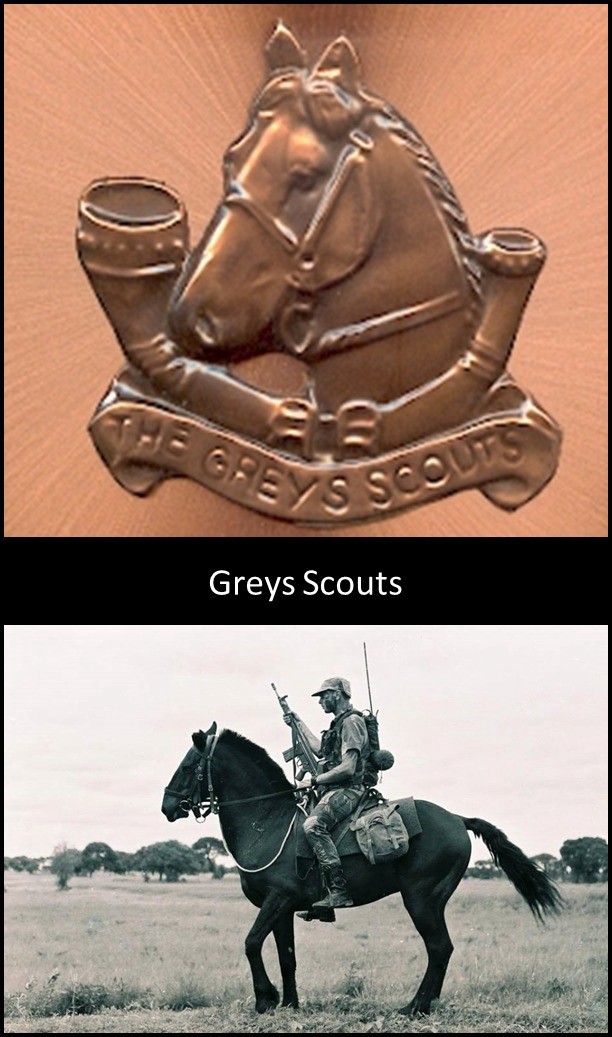
Grey's Scouts was founded by George Grey at the time of the Matabele Rebellion and became a crack mounted infantry regiment familiar to everyone who has connections to the old Rhodesia (Zimbabwe). This image from the front page of The Graphic of 8 August 1896 has the caption: The Matabele Revolt, Captain Grey's Scouts and the Afrikander Corps in Action.


Copyright Illustrated London News
Badge and Grey's Scouts Trooper c. 1970s
Copyright

Founder of the Copperbelt on the borders of Northern Rhodesia (Zambia) and Katanga (now part of Democratic Republic of Congo). It was George Grey who discovered and pegged the ancient African copper workings in the area and negotiated the concessions for many of the mines that still operate today.

Epic Cyclist. Horses too often fell prey to the diseases of Africa and George had to take to two wheels instead. Several of his epic journeys are detailed in the book Generation of Men by W.V. Brelsford, when travelling 600 miles in one week was nothing unusual. One example from 1899, when there was no railway, no mail service and no telegraph, George set off on his own by bicycle through rough country all the way from Katanga to Bulawayo, about 860 miles, carrying urgent information on the copper concessions. He accomplished this in less than a week and carried no equipment or arms but "merely a bottle of Bovril, some bars of chocolate and his razors. No-one ever saw him unshaven". 

Fighter of Slave-Traders. Also detailed in Generation of Men, are accounts of George and his African companions having fights with slave caravans, sending the slavers packing and releasing the slaves.

Special Commissioner for Swaziland. In the years 1907-1910, George, who could not abide red tape, managed to sort out much of the tangle of land concessions in Swaziland (now Eswatini). His work guaranteed that white people would be excluded from owning most of the best agricultural land and that it would remain with the Swazi people.

One of George's contemporaries, Frederick Selous, said of him "... one of the finest specimens of an Englishman in the country - quiet, self-contained and unassuming, but at the same time brave, capable and energetic".


George Grey
From the book, Generation of Men
Copyright W.V. Brelsford

For these and many other tales about George Grey, see Chapter 9 of Generation of Men by W.V. Brelsford, unfortunately not available to read in full online.

A number of other articles about Grey appear in old issues of the Northern Rhodesia Journal. Some of these can be accessed online via nrzam.org.uk but be aware that the website is old and not always reliable.


The family seat, Fallodon Hall, Northumberland


* An online family tree shows at least one child, a William Grey, born to George Henry Grey before he married Harriet Jane Pearson, but this would need more thorough investigation. This is not to say that George Henry didn’t have illegitimate children, but usually in such circumstances and at that time, such births were considered so disgraceful that the children may have been registered and baptised with either the surnames of the mothers, or those of foster or adoptive parents.

Thursday, February 7, 2019

A young lady and her book. (The Greys of Fallodon, Part I)


This little book, entitled Walks in a Forest, by Thomas Gisborne, M.A., and published by T. Cadell and W. Davies of Strand, London, in 1814, has been part of my family's book collection for many years.

I believe my father picked it up in an English second-hand bookshop, having spotted the bookplate that shows it once belonged in the library of the Greys of Fallodon, an aristocratic family with ties to his native county of Northumberland.


Walks in a Forest, 1814
10 x 16 cm


Bookplate
Grey of Fallodon

The tiny bookseller’s sticker in the top left hand corner showed that it was sold by T. Gibbons, Bookseller and Binder, of No. 5 Argyle Street, Bath. The building (No. 5 on the corner) still stands today, probably not too much different from how it was in 1817.


On another page in the book and in fading ink, the following is inscribed:


 “Anna Sophia Ryder, June 1817”.


A search of this lady shows her to have been the eldest of the thirteen children of The Rt. Rev. Henry Dudley Ryder, Bishop of Lichfield, and she was born on 18 January 1805 at the Lutterworth Parsonage, Leicestershire. Thus, she would have been just twelve-and-a-half years old when her name was inscribed in the book.

 
Statue of Bishop Ryder, father of Anna Sophia
Lichfield Cathedral.
Copyright The Victorian Web


Although one can never know how the young Anna came by the book, it is possible it was a gift or purchased during a visit to Bath in the season while visiting with members of her family. This was the height of the Regency era when Bath was the ton, or the place to be seen if you moved in the higher echelons of society.

Teenagers and pre-teens as we know them today with their own outspoken identities and cultures did not exist in those days. You were a child and then you were an adult, and the stage when you moved from one state to the other might be dependent on your physical maturity rather than a day on the calendar. (Anyone researching their family trees in the late 18th/early 19th Century knows the shocks that are in store as to the age some girls were married and/or gave birth or when boys became front-line soldiers.)

Being from a religious family it is debatable whether the young Anna, barely on the cusp of womanhood, would be permitted to attend the slightly risque gathering places of Regency Bath, but as she also had an aristocratic pedigree and several politicians in the family noted for their liberalism (and more than their fair share of illegitimate progeny among them), it is impossible to say. This extract about her father from the Oxford Dictionary of National Biography:-


... While participating fully in the fashionable social life expected of a clergyman of his means and connections, Ryder seems, from the beginning, to have taken his pastoral charge at Lutterworth and Claybrook with great seriousness. ... He was also attentive to the development of personal piety and to that of his family, whom he regularly assembled for the reading of prayers. His connections and his attention to his duty guaranteed further preferment, and in 1808 he was presented to a canonry of Windsor. His sermons in St George's Chapel were greatly admired by George III, who said that they reminded him of the divinity of former days ...


The romantic in me likes to imagine that young Miss Ryder may have strolled about looking at the sights of Bath with her mother or another chaperone, perhaps with this little book in her hand or with it carefully packaged and tucked in her reticule. Judging from the image below, one wonders if there might have been a trend to carry little poetry books around as a fashion accessory?

This image is dated August, 1817. Interesting that the book she is holding is the same size, with the same brown cover and rectangular emboss as my book and given the title of the image is also Walking Dress, it is very possibly a copy of Walks in a Forest.


Copyright CandiceHern

The text in the book is extremely florid by modern standards and is littered with explanatory footnotes, some in Greek or Latin, and it takes a lot of patience to read, let alone comprehend. Although the cover is battered, the inner pages are almost pristine and the spine has never been broken. Perhaps young Anna also found it a little tedious and was more interested in the comings and goings of the fashionable set in Regency Bath.

Another observation, in this 1814 edition the text has been updated into modern usage and no longer has the long "S" which looks like an "f". Here is a link to the earlier edition at Internet Archive.

It is very likely Anna was familiar with Jane Austen, whose works are famously linked with her time in Bath, and no doubt would have been saddened when the author was to die so soon, in July 1817. Another notable departure that year was the tragic loss in childbirth of the heiress apparent, Princess Charlotte, as a result of which twenty years later her cousin, Princess Victoria, was destined to become Queen, under whom Anna’s future husband would serve in government.

On 14 August 1827, in Holy Trinity Church, Eccleshall, Staffordshire, Anna married The Hon. Sir George Grey, who was at the time a lawyer in private practice but who one year later succeeded to the baronetcy as the 2nd Earl Grey, and in 1832 entered Parliament initially as the Whig member for Devonport and in later years as the member for Morpeth. He would serve under four Prime Ministers, often as Home Secretary, and played an important role in many of the major reforms during the Victorian era.  

The younger George Grey,
sketch by George Richmond
The older George Grey,
Carte de visite photograph,
National Portrait Gallery London

Anna and George had only one child, a son, George Henry Grey, born in 1835, who followed a career in the militia. He was equerry to the Prince of Wales (later King Edward VII) as can be seen in this extract from the 1871 Census where he was in residence with the Prince at Marlborough House.


In spite of the strong moral principles of his father, George Henry seems to have followed in the footsteps of his other rakish relatives (and his boss, the Prince of Wales, for that matter!) as, according to an online family tree, he had two illegitimate children as well as seven legitimate ones.  George Henry died quite young, in December 1874, at Sandringham and the Prince of Wales attended his funeral service in Northumberland.


It must have been a terrible blow for Anna and George to lose their only son, but they went on to play important roles in raising their grandchildren, one of whom would become the more famous Edward Grey, 1st Viscount of Fallodon.

This report is from the Yorkshire Post and Leeds Intelligencer of 18 December, 1874:-

FUNERAL OF LIEUT.-COLONEL GREY.The remains of Lieut.-Colonel George Henry Grey, only son of the Right Hon. Sir George Grey, Bart., G.C.B, of Falloden, Northumberland, and one of the equerries of his Royal Highness the Prince of Wales, were interred shortly before noon yesterday, in the family vault, in the small churchyard of Embleton, situated about two miles from Falloden. The Prince of Wales was present, having arrived in the North on the preceding evening, and become the guest during his short stay of Earl Grey, at Howick Hall, which is only short distance from Falloden.The deceased gentleman expired after short illness, at the Equerries' Lodge, Sandringham, whence his body was removed to the family seat. He caught a severe cold whilst on short visit to Falloden three weeks ago, but proceeded to Sandringham, where congestion of the lungs afterwards set in, and he died yesterday week, the immediate cause of death being inflammation of the pleuris. The funeral procession, which consisted of hearse and five mourning coaches, left Falloden at eleven o'clock, and, on its arrival, was joined by the Prince of Wales, Earl Grey, the Duke of Northumberland, Earl Percy, M.P., and a number of the neighbouring gentry. [Full list of attendees not included here].A large assemblage of the neighbouring agricultural population was in the vicinity of the churchyard and on the route, and they evinced every mark of respect for the memory of the deceased and at his untimely end. There were also present the permanent staff of the Northumberland Light Infantry Militia, of which the deceased gentleman was lieutenant-colonel. The burial service was read by the Rev. W. Streatfeild, rector of Howick. The Prince of Wales left in the afternoon express train for the south.

When he died in 1882, George had been married to Anna for 55 years, a record these days and even more remarkable then. Anna herself died in December 1893 just before her 89th birthday.

Unfortunately, I have been unable to find any images of Anna when she was alive, but here is the memorial to her and George in the Holy Trinity Churchyard, Embleton, Northumberland. Copyright Find-a-Grave.


Fallodon Hall no longer belongs to the Grey family, but is occasionally open to the public under the Open Garden Scheme


More to come on other Greys of Fallodon in a future post.